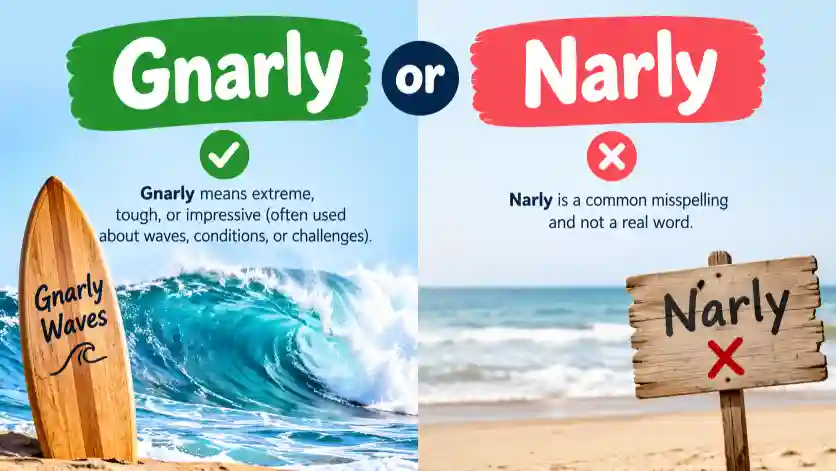
Gnarly is the correct spelling of the standard English word used to describe something rough, twisted, difficult, dangerous, or impressive. Narly is a misspelling of gnarly in standard English. These words can cause confusion because the initial “g” in gnarly is silent, so the word sounds like “narly” when spoken.
People often use gnarly in casual conversations, sports, surfing, and online discussions. Depending on the context, it can describe a twisted tree branch, a challenging skateboard trick, rough waves, or something particularly impressive. It can also describe an unpleasant or difficult situation.
Understanding the difference between gnarly and narly helps you avoid spelling mistakes in school assignments, emails, social media posts, and everyday writing. Although the two spellings may sound alike, only gnarly is the accepted standard spelling.
In this guide, you will learn the meaning, origin, correct usage, common mistakes, and practical examples of gnarly or narly.
Gnarly or Narly : Quick Answer
Gnarly is the correct spelling in standard English. Narly is generally considered incorrect when you intend to use the word gnarly.
| Word | Correct or Incorrect? | Meaning |
| Gnarly | Correct | Rough, twisted, difficult, dangerous, or impressive |
| Narly | Incorrect for this meaning | A nonstandard misspelling of gnarly |
Examples:
- Correct: “That was a gnarly skateboard trick.”
- Incorrect: “That was a narly skateboard trick.”
Remember: The letter g is silent, but it must remain in the spelling.
Definition and Meaning of Gnarly and Narly
What Does Gnarly Mean?
Gnarly is an adjective with several meanings. It can describe something physically rough or twisted, something challenging or dangerous, or something impressive in informal speech.
The intended meaning depends on the context.
Examples:
- “The old tree had gnarly branches.” Here, gnarly describes branches that are twisted and rough.
- “She completed a gnarly mountain-bike trail.” Here, gnarly means difficult or challenging.
- “That was a gnarly wave!” Here, it expresses excitement about an impressive or powerful wave.
In informal American English, gnarly can have both negative and positive meanings. It might describe something unpleasant, frightening, or extremely challenging, but it can also express admiration.
What Does Narly Mean?
Narly is not the standard spelling of the adjective gnarly. Writers sometimes use it by mistake because the two forms sound the same.
If you want to describe something rough, twisted, challenging, or impressive, write gnarly, not narly.
Incorrect: “The surfer rode a narly wave.”
Correct: “The surfer rode a gnarly wave.”
The word narly should not replace gnarly in standard writing.
Origin and History of Gnarly
The word gnarly developed from the word gnarl, which refers to a knot or twisted part of wood, such as a tree trunk or branch.
The term originally described something rough, knotted, or twisted. Over time, its meaning expanded beyond physical objects.
By the late 20th century, gnarly became especially associated with surfing and skateboarding culture. People began using it to describe difficult waves, challenging tricks, and intense experiences.
Today, the word has a wider informal meaning. Someone might call a difficult exam, a dangerous mountain road, or an impressive athletic performance gnarly.
The spelling has remained gnarly, even though the initial g is silent. The spelling narly is usually the result of hearing the word rather than learning its written form.
British English vs. American English Spelling
The spelling of gnarly does not change between British and American English. Both varieties use the same spelling.
| Feature | American English | British English |
| Correct spelling | Gnarly | Gnarly |
| Incorrect spelling for this meaning | Narly | Narly |
| Pronunciation | The initial g is silent | The initial g is silent |
| Common usage | Informal speech, sports, and popular culture | Informal speech and popular culture |
| Formal writing | Use only when appropriate to the context | Use only when appropriate to the context |
Although the spelling is identical, the word may appear more frequently in particular informal settings, such as American surfing and skateboarding culture.
The key point is simple: use gnarly in both British and American English.
Which Spelling Should You Use?
Use Gnarly in Everyday Writing
Choose gnarly when describing something twisted, rough, difficult, dangerous, or impressive.
Examples:
- “The climbers faced a gnarly section of the mountain.”
- “He showed us a gnarly scar from an old injury.”
- “That was a gnarly trick on the skateboard.”
- “The storm created some gnarly waves.”
Each sentence uses the standard spelling correctly.
Avoid Narly as a Substitute
Do not use narly when you mean the adjective gnarly. The spelling may reflect how the word sounds, but it is not the standard written form.
For schoolwork, professional communication, articles, and other edited content, always write gnarly.
When Is Gnarly Appropriate?
The word is informal and expressive. It works well in conversations, blogs, sports reports with a casual tone, and social media posts.
In formal or technical writing, a more precise alternative may be better.
For example:
- Informal: “The road was gnarly.”
- More precise: “The road was steep, uneven, and dangerous.”
Choose the wording that best fits your audience and purpose.
Common Mistakes With Gnarly and Narly
Writers often make spelling mistakes with gnarly because its pronunciation does not clearly reveal its first letter.
1. Writing Narly Because the G Is Silent
Incorrect: “The skateboarder performed a narly trick.”
Correct: “The skateboarder performed a gnarly trick.”
Why? The initial g is silent, but it remains part of the correct spelling.
2. Assuming Gnarly Only Means Dangerous
Incorrect assumption: “Gnarly always describes something dangerous.”
Correct understanding: Gnarly can mean rough, twisted, difficult, unpleasant, or impressive.
Example: “That was a gnarly performance!” In this sentence, the speaker may be expressing admiration.
3. Using Gnarly in Formal Writing Without Considering the Tone
Less suitable for a formal report: “The hikers faced a gnarly route.”
More suitable: “The hikers faced a challenging and hazardous route.”
Why? Gnarly is informal. A precise description may be more appropriate in professional or academic writing.
4. Treating Narly as an Alternative Spelling
Incorrect: “Both gnarly and narly are accepted spellings.”
Correct: Gnarly is the standard spelling for the meanings discussed here.
Remembering this distinction will help you write confidently.
Gnarly or Narly in Everyday Examples
The following examples show how to use gnarly correctly in different situations. Notice the bolded word in every example.
1. In Everyday Conversations
- “That was a gnarly bike ride through the mountains.”
- “You should see the gnarly scratch on my car.”
- “The waves look gnarly today.”
These sentences show how the word can describe a challenging experience, a rough mark, or powerful waves.
2. In Sports and Outdoor Activities
- “The surfer caught a gnarly wave.”
- “She completed a gnarly downhill mountain-bike course.”
- “The skateboarder landed a gnarly trick.”
In sports, gnarly often describes something difficult, intense, or impressive.
3. In School and Study
- “The final mathematics problem was gnarly.”
- “We had to solve a gnarly physics question.”
- “The science project involved a gnarly technical challenge.”
Here, the word describes something complicated or difficult. In formal school assignments, complex or challenging may be more suitable.
4. In Emails and Workplace Conversations
- “The team faced a gnarly technical problem during testing.”
- “We spent the morning fixing a gnarly software bug.”
- “That was a gnarly issue to resolve.”
These examples work in casual workplace conversations. In formal business reports, terms such as complex, serious, or difficult may communicate the meaning more precisely.
5. In Social Media Posts
- “What a gnarly wave!”
- “Just finished a gnarly trail ride.”
- “That skateboard trick was gnarly!”
The word suits informal posts because it conveys excitement and strong emotion.
6. Incorrect and Correct Spelling Examples
| Incorrect Sentence | Correct Sentence |
| That was a narly wave. | That was a gnarly wave. |
| He tried a narly skateboard trick. | He tried a gnarly skateboard trick. |
| The tree had narly branches. | The tree had gnarly branches. |
| We faced a narly challenge. | We faced a gnarly challenge. |
The correction in every sentence is the same: replace narly with gnarly.
Usage Trends and Modern Writing
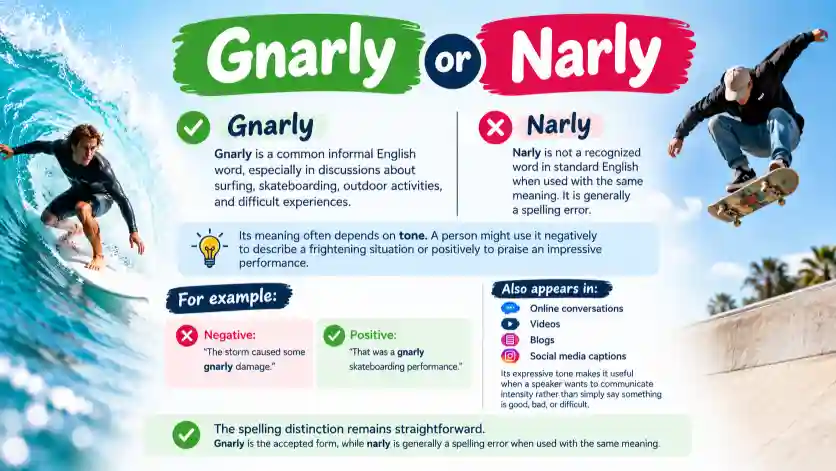
Gnarly remains a recognizable informal English word, especially in discussions about surfing, skateboarding, outdoor activities, and difficult experiences.
Its meaning often depends on tone. A person might use it negatively to describe a frightening situation or positively to praise an impressive performance.
For example:
- Negative: “The storm caused some gnarly damage.”
- Positive: “That was a gnarly skateboarding performance.”
The word also appears in online conversations, videos, blogs, and social media captions. Its expressive tone makes it useful when a speaker wants to communicate intensity rather than simply say something is good, bad, or difficult.
However, the spelling distinction remains straightforward. Gnarly is the accepted form, while narly is generally a spelling error when used with the same meaning.
Gnarly vs. Narly: Comparison Table
| Feature | Gnarly | Narly |
| Standard spelling | Yes | No, for this meaning |
| Part of speech | Adjective | Not a standard substitute for this adjective |
| Pronunciation | Usually sounds like “nar-lee” | Often intended to sound the same |
| Describes twisted objects | Yes | No |
| Describes difficult situations | Yes | No |
| Can express admiration | Yes, informally | No standard usage |
| Recommended for published writing | Yes, when appropriate | No |
Bottom line: If you want to describe something rough, twisted, difficult, dangerous, or impressive, choose gnarly.
Easy Trick to Remember Gnarly
Use this simple memory trick:
Gnarly has a silent G, just like other English words that begin with “gn.”
Think of the word gnat. The first letter is silent, but you still write it.
- Gnarly = Correct
- Narly = Incorrect for the intended meaning
You can also remember the phrase: “Gnarly starts with G, even when you cannot hear it.”
This small reminder can help you avoid the mistake in everyday writing.
Frequently Asked Questions
1. Is gnarly or narly correct?
Gnarly is correct in standard English. Narly is generally a misspelling when used to describe something rough, twisted, difficult, or impressive.
2. What does gnarly mean?
Gnarly is an informal adjective that can mean rough, twisted, difficult, dangerous, unpleasant, or impressive. The intended meaning depends on the context.
3. Is the G silent in gnarly?
Yes. The initial g in gnarly is silent, so the word usually sounds like “nar-lee.” However, you must include the letter g when writing it.
4. Can gnarly mean good?
Yes. In informal language, gnarly can express admiration or excitement. For example, “That was a gnarly trick!” can mean that the trick was impressive.
5. Can gnarly have a negative meaning?
Yes. Gnarly can describe something unpleasant, dangerous, rough, or difficult. For example, “The hikers faced a gnarly storm” suggests a challenging or potentially dangerous situation.
6. Is gnarly slang?
Gnarly is an informal word strongly associated with surfing and skateboarding culture. It is also used more broadly in casual conversations and online writing.
7. Is gnarly used in British English?
Yes. Gnarly can be used in British English, and its spelling is the same as in American English. It is generally informal in both varieties.
8. What is a synonym for gnarly?
Depending on the context, possible synonyms include rough, twisted, challenging, difficult, dangerous, intense, and impressive. Choose a synonym that matches the intended meaning.
9. How do you pronounce gnarly?
Gnarly is commonly pronounced “NAR-lee.” The first letter, g, is silent.
10. Why do people spell gnarly as narly?
People may write narly because they spell the word the way it sounds. The initial g is silent, which makes the correct spelling less obvious to some writers.
Conclusion
The difference between gnarly and narly is simple: gnarly is the correct standard spelling, while narly is generally incorrect when used with the same meaning.
Use gnarly to describe something rough, twisted, difficult, dangerous, or impressive. Although the word is informal, it is common in conversations about sports, outdoor adventures, and everyday experiences.
Remember the silent g, check the spelling before publishing, and choose more precise alternatives when writing in a formal or academic style.
Read More:
- Ither or Either? The Simple Trick to Remember the Spelling
- Comrad or Comrade: Stop Making This Common Spelling Mistake
- Tie or Tye? The One Spelling You Should Never Get Wrong Again







2 thoughts on “Gnarly or Narly: The Simple Trick to Remember the Correct Word”