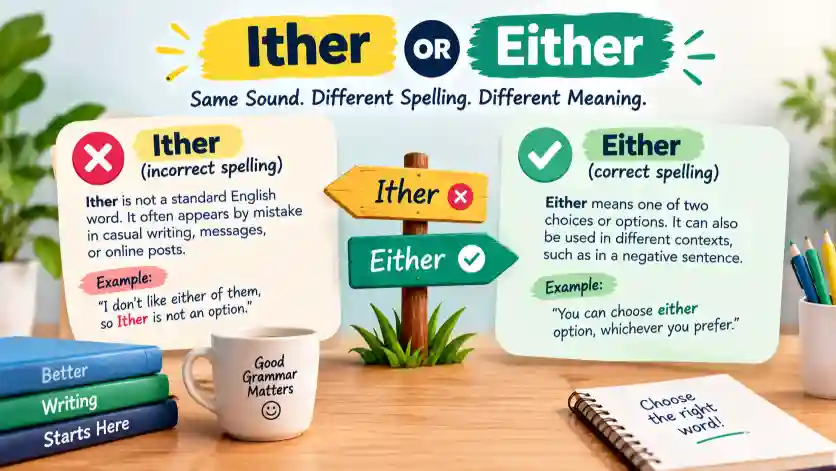
Either is the correct standard English spelling, while ither is a common misspelling. The word either is used when referring to one of two choices, agreeing with a negative statement, or connecting alternatives in a sentence. For example, “You can choose either option” means you may select one of the two options.
People often confuse ither and either because the first vowel sound in either can vary between speakers. Some pronounce it “EE thur,” while others say “EYE thur.” Both pronunciations are accepted in standard English, but the spelling remains either.
If you are writing an email, school assignment, article, or everyday message, use either rather than ither. Learning this simple difference can help you avoid spelling errors and express choices more clearly.
In this guide, you will learn the meanings of either, its origin, British and American usage, common mistakes, and practical examples to help you remember the correct spelling.
Quick Answer: Ither or Either?
- Either: The correct standard English spelling.
- Ither: A common misspelling of either.
- Meaning: One of two choices, or used to connect alternatives.
- Example: “You can choose either the red shirt or the blue shirt.”
Easy rule: Always write either when you mean one of two options or use the word in expressions such as “me either” in informal speech or “either…or” in a sentence.
Definition and Meaning of Either
The word either has several uses in English. Its meaning depends on how it appears in a sentence.
1. Either as a Determiner
As a determiner, either refers to one of two people or things.
Examples:
- “You can take either road.”
- “Either answer is acceptable.”
- “You may choose either book.”
- “Either candidate could win the election.”
In these sentences, either indicates that one of two available choices is possible.
2. Either as a Pronoun
Either can also work as a pronoun when the noun is understood from the context.
Examples:
- “Both dresses look nice. You can buy either.”
- “I have two pens. You can use either.”
- “There are two seats available. Either is fine.”
Here, either replaces a noun and refers to one of two options.
3. Either as a Conjunction
The word often appears in the structure either…or to present two alternatives.
Examples:
- “You can either walk or take the bus.”
- “Either we leave now, or we will be late.”
- “She wants either tea or coffee.”
- “You can either call me or send a message.”
This structure helps readers understand the choices being presented.
4. Either in Negative Sentences
Either can appear at the end of a negative sentence to add another negative statement.
Examples:
- “I do not like coffee either.”
- “He cannot swim, and I cannot swim either.”
- “She did not attend the meeting either.”
In this use, either often means “also not” or “not as well.”
What Does Ither Mean?
Ither is not the standard spelling of the English word either. People may write it by mistake because they hear different pronunciations of either or accidentally leave out the first letter.
For example:
Incorrect: “You can choose ither option.”
Correct: “You can choose either option.”
Another example:
Incorrect: “I do not want ither one.”
Correct: “I do not want either one.”
When you mean one of two choices, use either. In ordinary English writing, ither should be treated as a spelling error.
Origin of the Word Either
The word either developed from Old English forms related to the idea of one of two. Its historical spelling and pronunciation changed over time as English developed.
Today, the word is used to express a choice between two alternatives, refer to one of two items, or add agreement to a negative statement.
Although pronunciation varies among English speakers, the standard spelling is stable: either.
The misspelling ither does not replace the accepted spelling in standard modern English.
Either in British and American English
The spelling either is the same in British and American English. The main difference people notice is pronunciation.
| Feature | British English | American English |
| Standard spelling | Either | Either |
| Common pronunciation | EE thuh or EYE thuh | EE thur or EYE thur |
| Meaning | One of two choices; also used in negative statements | One of two choices; also used in negative statements |
| Is ither standard? | No | No |
Both major varieties of English accept the two common pronunciations of either. Neither pronunciation changes the spelling.
Remember: Pronunciation can vary, but the correct spelling remains either.
Which Spelling Should You Use?
Use either in all standard English writing when you mean one of two options or need the word for another accepted grammatical use.
Use Either When Presenting Two Choices
Examples:
- “You can choose either dress.”
- “Either answer will work.”
- “We can travel by either train or bus.”
Use Either in an Either…Or Structure
Examples:
- “You can either study now or study later.”
- “Either Sarah or James will lead the team.”
- “We will either eat at home or visit a restaurant.”
Use Either at the End of a Negative Sentence
Examples:
- “I do not understand the question either.”
- “He did not call me either.”
- “They are not ready, and we are not ready either.”
Avoid Ither in Formal and Informal Writing
Do not use ither as a replacement for either in essays, emails, blog posts, reports, or messages.
Incorrect: “I can meet you ither today or tomorrow.”
Correct: “I can meet you either today or tomorrow.”
Common Mistakes with Ither and Either
The spelling is simple, but some related grammar rules can cause confusion.

1. Leaving Out the First Letter
Incorrect: “I will take ither option.”
Correct: “I will take either option.”
The standard word begins with the letter e.
2. Confusing Either with Neither
Either commonly presents one of two choices. Neither means not one and not the other.
Examples:
- Either: “Either answer is correct.”
- Neither: “Neither answer is correct.”
The meanings are different, so choose the word that matches your message.
3. Using Either Without a Clear Choice
The word either often refers to two alternatives. If you are presenting several choices, another word may be clearer.
Less clear: “You can choose either of these five books.”
Better: “You can choose any of these five books.”
Use either when the intended choice is between two items or alternatives.
4. Misusing Either…Or
The structure either…or connects alternatives. Keep the sentence balanced when possible.
Less balanced: “She wants either to study or a job.”
Better: “She wants either to study or to find a job.”
The second sentence uses two matching verb phrases.
5. Confusing Pronunciation with Spelling
Some speakers pronounce either with an “EE” sound, while others use an “EYE” sound.
Both are accepted pronunciations.
Incorrect spelling: “Ither option is fine.”
Correct spelling: “Either option is fine.”
The sound you prefer does not change the spelling.
Everyday Examples of Either
These examples show how to use either in common situations.
1. In Daily Conversations
- “You can sit on either side.”
- “Either choice is fine with me.”
- “We can go either today or tomorrow.”
2. At School
- “Either student can answer the question.”
- “You may write with either pen.”
- “Either method can help you solve the problem.”
3. At Work
- “You can contact me by either phone or email.”
- “Either meeting time works for me.”
- “Either department can handle the request.”
4. In Shopping
- “You can buy either color.”
- “Either pair of shoes would look good.”
- “I would accept either offer.”
5. In Negative Statements
- “I do not like spicy food either.”
- “She did not finish the assignment either.”
- “We cannot attend the event either.”
These examples demonstrate the different grammatical roles of either.
Ither or Either: Comparison Table
| Feature | Ither | Either |
| Standard English spelling | No | Yes |
| Refers to one of two choices | No | Yes |
| Used in either…or | No | Yes |
| Used in negative statements | No | Yes |
| Suitable for standard writing | No, as a spelling of this word | Yes |
| Example | “Ither option is fine.” | “Either option is fine.” |
The correct choice is either in standard English writing.
Frequently Asked Questions
1. Is it ither or either?
Either is the correct standard English spelling. Ither is a common misspelling and should not be used when referring to one of two choices.
2. Why do people spell either as ither?
People may leave out the first letter by mistake or become confused by the different ways either is pronounced. The accepted spelling still includes the initial e.
3. Is either pronounced EE thur or EYE thur?
Both pronunciations are accepted in standard English. The preferred pronunciation varies by speaker and region, but the spelling remains either.
4. What does either mean?
Either can refer to one of two choices, connect alternatives in an either…or structure, or appear at the end of a negative statement to mean “also not.”
5. Is either used in British and American English?
Yes. Either is the standard spelling in both British and American English. The main variation is pronunciation, not spelling.
6. What is the difference between either and neither?
Either generally refers to one of two options. Neither means not one and not the other.
Example: “Either route is fine” means both routes are possible choices. “Neither route is open” means both routes are closed.
7. Can I use ither in an essay or email?
No. If you mean either, use the correct spelling in essays, emails, reports, and everyday messages. Writing ither will usually be considered a spelling mistake.
Conclusion: Ither or Either?
The correct spelling is either, not ither. Use either when referring to one of two choices, connecting alternatives with either…or, or adding a negative statement at the end of a sentence.
For example, “You can choose either option” presents two possible choices. “I do not want coffee either” adds a negative statement. In both cases, the spelling remains the same.
Remember that either can be pronounced in two common ways: “EE thur” and “EYE thur.” Both pronunciations are accepted in standard English, so you can use the one that feels natural to you. However, pronunciation does not change the spelling.
To avoid mistakes, remember the initial e in either. This simple rule will help you write clearly in school assignments, workplace messages, articles, and everyday conversation.
Read More:
- Comrad or Comrade: Stop Making This Common Spelling Mistake
- Tie or Tye? The One Spelling You Should Never Get Wrong Again
- Caput or Kaput? The Right Answer Will Surprise You








3 thoughts on “Ither or Either? The Simple Trick to Remember the Spelling”