
Comrade is the correct English spelling, while comrad is a common misspelling. The word comrade refers to a companion, colleague, or fellow member of a group who shares a common purpose, activity, or belief. It is often used when talking about friendship, teamwork, political movements, military service, or people working toward the same goal.
Many people confuse comrad and comrade because the final e may be difficult to hear in everyday speech. However, when writing in English, that final letter is essential. Using the correct spelling makes your sentences clearer and helps you communicate more professionally.
For example, you might write, “He thanked his comrade for standing beside him during difficult times.” Writing comrad instead would be a spelling mistake.
In this guide, you will learn the meanings of comrade and comrad, explore the word’s origin, understand British and American usage, and discover common mistakes with practical examples. You will also find a simple memory trick and answers to frequently asked questions to help you use the word confidently in everyday conversations and formal writing.
Comrad or Comrade : Quick Answer
Comrade is the correct spelling in standard English. Comrad is an incorrect spelling when you intend to use the word meaning a companion or fellow member of a group.
- Correct: Every comrade supported the team during the difficult period.
- Incorrect: Every comrad supported the team during the difficult period.
A comrade can be a friend, colleague, fellow soldier, or person who shares a common cause.
Easy rule: Always write comrade with an e at the end.
Definition and Meaning of Comrade and Comrad
What Does Comrade Mean?
A comrade is someone who shares an activity, experience, responsibility, or common purpose with another person. The word can describe a companion, colleague, fellow soldier, or member of a group.
It is especially associated with people who work together toward a shared goal or support one another during challenging situations.
Examples:
- He thanked his comrade for helping him during the crisis.
- The soldiers trusted their comrades on the battlefield.
- She worked closely with her comrades to complete the project.
- Every comrade contributed to the group’s success.
The word can also be used as a form of address in political organizations, labor movements, and groups with shared ideological commitments.
What Does Comrad Mean?
Comrad is a common misspelling of comrade when referring to a companion or fellow member of a group.
It is not the standard spelling of the English word. People may leave out the final e because they are unfamiliar with the written form or spell the word according to how they hear it.
Examples:
- Incorrect: He discussed the plan with his comrad.
- Correct: He discussed the plan with his comrade.
When you mean a companion or someone who shares your goals, use comrade.
Comrad vs. Comrade: Key Differences
| Feature | Comrade | Comrad |
| Spelling | Correct | Common misspelling |
| Standard dictionary word for a companion | Yes | No |
| Meaning | Companion or fellow member | No standard meaning in this context |
| Common context | Friendship, teamwork, military, politics | Usually an attempted spelling of comrade |
| Example | She trusted her comrade. | She trusted her comrad. |
| Recommended use | Use it | Avoid it for this meaning |
Origin and History of Comrade
Where Does the Word Comrade Come From?
The word comrade entered English through French camarade, which came from Spanish camarada. The Spanish word originally referred to a group of people sharing a room or chamber, and it developed from cámara, meaning “chamber.”
Over time, the meaning expanded from people who shared living space to companions who shared experiences, responsibilities, or goals.
By the nineteenth and twentieth centuries, comrade had become strongly associated with military relationships, political movements, labor organizations, and socialist or communist groups.
Today, the word can refer more broadly to a companion or fellow member of a group, although its tone depends on the context.
Why Do People Write Comrad?
The spelling comrad often results from leaving out the final letter e. Since the ending may not be strongly pronounced in ordinary conversation, writers sometimes misspell the word.
However, the accepted spelling remains comrade.
British English vs. American English
The spelling comrade is standard in both British and American English. There is no major regional spelling difference between the two varieties.
| Context | British English | American English |
| Correct spelling | Comrade | Comrade |
| General meaning | Companion or fellow member | Companion or fellow member |
| Military context | The soldiers supported their comrades. | The soldiers supported their comrades. |
| Political context | The speaker addressed his comrades. | The speaker addressed his comrades. |
| Common misspelling | Comrad | Comrad |
The word has the same basic meaning in both varieties. Its tone may vary depending on the speaker, organization, historical setting, or political context.
For international writing, always use comrade when referring to a companion or fellow member.
Which Spelling Should You Use: Comrad or Comrade?
Choosing between these forms is simple because only one is the standard spelling of the word you need.
When to Use Comrade
Use comrade when referring to someone who shares a common activity, experience, responsibility, or cause.
Examples:
- He remained loyal to his comrade during difficult times.
- The soldiers relied on their comrades for support.
- She collaborated with her comrades to organize the event.
- Every comrade played a role in achieving the group’s objective.
The word is suitable for historical writing, literature, discussions of military service, political contexts, and descriptions of people united by a common purpose.
When Not to Use Comrad
Avoid comrad when you intend to write the standard English word for a companion or fellow member.
Incorrect: My comrad helped me finish the assignment.
Correct: My comrade helped me finish the assignment.
The same rule applies to formal documents, school assignments, professional communication, and online articles.
Common Mistakes With Comrad and Comrade
The difference is mainly a spelling issue, but a few related misunderstandings can also cause problems.
1. Leaving Out the Final E
Incorrect: He thanked his comrad for the support.
Correct: He thanked his comrade for the support.
Explanation: The standard spelling ends in -rade, including the final e.
2. Using Comrad in Formal Writing
Incorrect: Each comrad received recognition for the work.
Correct: Each comrade received recognition for the work.
Explanation: Use the standard spelling in academic, professional, and published writing.
3. Assuming Comrade Always Means a Close Friend
Incorrect: A comrade must always be someone’s best friend.
Correct: A comrade can be a companion, colleague, or fellow member of a group.
Explanation: The word often suggests shared experiences or a common purpose, but it does not necessarily describe an intimate friendship.
4. Ignoring the Political Context
Less precise: The word comrade always refers to a political supporter.
Better: The word comrade can refer to a companion generally, although it is also associated with particular political movements.
Explanation: Its meaning depends on the situation. It can be used outside political discussions.
5. Confusing Spelling With Pronunciation
Incorrect assumption: If the final e is not clearly heard, it can be omitted from the spelling.
Correct: The word is spelled comrade, even when the final vowel sound is weak.
Explanation: Standard spelling does not change simply because a letter is less noticeable in speech.
Everyday Examples of Comrade and Comrad
These examples show how comrade can be used in different situations.
1. In Friendship
“He stood beside his comrade when everyone else walked away.”
Here, comrade describes a companion who offered support during a difficult time.
2. In the Military
“The soldier relied on his comrades during the mission.”
The word refers to fellow soldiers who share responsibilities and experiences.
3. In the Workplace
“She worked with her comrades to complete the important assignment.”
In this context, comrades describes people working together toward a common goal. In an ordinary modern workplace, colleagues or teammates may sound more natural.
4. In Political Discussions
“The speaker addressed his comrades before the meeting began.”
Here, the word refers to fellow members or supporters of the same political movement or organization.
5. In Historical Writing
“The comrades continued their campaign despite the difficulties.”
The word describes people united by a shared cause.
6. In Literature
“The hero refused to abandon his comrade during the journey.”
Here, comrade emphasizes loyalty and companionship.
7. In Team Activities
“Every comrade contributed to the group’s final achievement.”
The sentence describes members working together toward a shared objective.
8. In Spelling Practice
“Comrade is the correct spelling, while comrad is a common misspelling.”
This example directly explains the difference between the two forms.
Comrad or Comrade: Usage Trends and Modern Writing
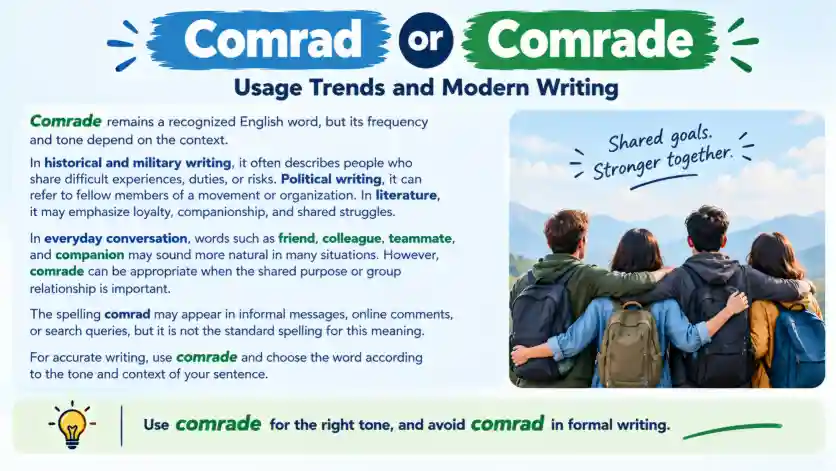
Comrade remains a recognized English word, but its frequency and tone depend on the context.
In historical and military writing, it often describes people who share difficult experiences, duties, or risks. Political writing, it can refer to fellow members of a movement or organization. In literature, it may emphasize loyalty, companionship, and shared struggles.
In everyday conversation, words such as friend, colleague, teammate, and companion may sound more natural in many situations. However, comrade can be appropriate when the shared purpose or group relationship is important.
The spelling comrad may appear in informal messages, online comments, or search queries, but it is not the standard spelling for this meaning.
For accurate writing, use comrade and choose the word according to the tone and context of your sentence.
Comrad vs. Comrade: Comparison Table
| Example sentence | Correct choice | Explanation |
| He trusted his during the mission. | Comrade | Refers to a fellow member or companion |
| The soldier thanked his . | Comrade | Describes a fellow soldier |
| She worked with every on the project. | Comrade | Refers to someone sharing a common purpose |
| The speaker addressed his at the meeting. | Comrade | Refers to fellow group members |
| He refused to abandon his . | Comrade | Emphasizes companionship and loyalty |
| Every helped the group succeed. | Comrade | Describes a member of a group |
| The historical account described the soldiers as . | Comrades | Correct plural form |
| He wrote a letter to his old . | Comrade | Correct spelling for a companion |
In every example, comrade or its plural form comrades is the appropriate spelling.
Easy Trick to Remember Comrad or Comrade
Use this simple trick to remember the correct spelling.
Comrade ends with E.
Remember the complete word as:
C-O-M-R-A-D-E
The final e is part of the correct spelling, even when it is not strongly pronounced.
You can also connect the word with companionship: a comrade is someone who shares a common cause or experience with you.
Examples:
- Correct: My comrade helped me during the challenge.
- Incorrect: My comrad helped me during the challenge.
Whenever you write the word, check the final letter before submitting your work.
Frequently Asked Questions (FAQs)
1. Is it comrad or comrade?
Comrade is the correct spelling in standard English. Comrad is a common misspelling when referring to a companion or fellow member of a group.
2. What does comrade mean?
A comrade is a companion, colleague, or fellow member who shares an activity, experience, responsibility, or common purpose with another person.
3. Is comrad a real word?
Comrad is not the standard spelling of the English word for a companion. It is generally considered a misspelling of comrade in this context.
4. How do you pronounce comrade?
In common English pronunciation, comrade is often pronounced approximately KOM-rad, with the final e not pronounced as a separate vowel. Pronunciation can vary slightly by accent.
5. What is the plural of comrade?
The plural is comrades.
Example: “The comrades worked together to complete the task.”
6. Is comrade a formal word?
It can be used in formal writing, historical accounts, military contexts, and political discussions. In everyday situations, friend, colleague, or teammate may be more natural.
7. Does comrade always have a political meaning?
No. Although the word is associated with political movements, it can also describe companions or people who share experiences and responsibilities.
8. Is comrade used in British and American English?
Yes. Comrade is the standard spelling in both British and American English.
9. What is another word for comrade?
Depending on the context, alternatives include companion, colleague, teammate, fellow member, and associate.
10. How can I remember the spelling of comrade?
Remember that comrade ends with the letter E. Writing the complete spelling, C-O-M-R-A-D-E, can help you avoid the common mistake of leaving out the final letter.
Conclusion
The difference between comrad and comrade is straightforward. Comrade is the correct English spelling for a companion, colleague, or fellow member of a group united by shared experiences or a common purpose. Comrad is a common misspelling of this word.
Although comrade is often associated with military service and political movements, it can also describe companionship and teamwork. Its exact tone depends on the context in which it is used.
Remember the simple rule: comrade always ends with E. Using the correct spelling will help you communicate clearly in everyday conversations, academic assignments, and professional writing.
Read More:
- Tie or Tye? The One Spelling You Should Never Get Wrong Again
- Caput or Kaput? The Right Answer Will Surprise You
- Cowlick or Calic: Can You Guess Which One Is Correct?









2 thoughts on “Comrad or Comrade: Stop Making This Common Spelling Mistake”