
Mayo and mayonnaise are the same condiment. Mayo is simply the short, informal form of mayonnaise, not a different sauce.
Many people search for mayo or mayonnaise because menus, recipes, and shops use both words for what looks like the same jar. The short word can make people wonder if the ingredients, taste, or quality are different.
In this guide, you will learn the clear meaning of each word, where mayonnaise came from, and when to use the short form. You will also learn about flavoured mayo, light mayo, and products that are not real mayonnaise at all.
By the end, you will know exactly which word fits a recipe, a menu, a shopping list, and a formal piece of writing. You will also know how to spot a real mayonnaise jar, how to store it safely, and why a product called dressing or spread is not always the same thing.
Mayo or Mayonnaise : Quick Answer
The Short Answer
Mayo is short for mayonnaise. Both words mean the same thick, creamy sauce made from oil, egg yolk, and an acid such as vinegar or lemon juice. The only real difference is style: mayonnaise is the full, formal name, and mayo is the short, casual name.
Quick Examples
1 Example : Please pass the mayo for my sandwich.
2 Example : This potato salad is made with homemade mayonnaise.
3 Example : Chipotle mayo is mayonnaise mixed with chipotle flavour, not a different base sauce.
Definition and Meaning of Mayo or Mayonnaise
What Is Mayonnaise?
Mayonnaise is a cold, creamy emulsion. Oil and water-based ingredients do not mix on their own, but egg yolk contains lecithin, which holds them together in a smooth, thick sauce. The basic ingredients are oil, egg yolk, and vinegar or lemon juice, plus salt and often mustard for flavour.
What Is Mayo?
Mayo is a clipping, a shortened form, of mayonnaise. It became common in the United States by about 1930, and it is now used in everyday speech in many countries. In food talk, mayo and mayonnaise point to the same jar, the same spread, and the same sauce.
Other Meanings of Mayo to Watch For
In food writing, mayo almost always means mayonnaise. Outside food, Mayo can also be a place name, such as County Mayo in Ireland, and a name in Mayo Clinic. In slang, the word has also been used in other, unrelated ways, so context matters. If the topic is food, mayo means mayonnaise.
The Origin of Mayo or Mayonnaise
Where Did Mayonnaise Come From?
The exact origin is debated, but the most common story points to Mahón, the capital of Menorca in Spain. After the city was taken in 1756, a sauce of oil and egg was served to the French Duc de Richelieu, and the sauce, called mahonnaise, was brought to France. Other stories point to Bayonne in France, and to old French words for egg yolk and stirring.
How Did Mayo Appear?
Mayonnaise entered English from French in the early 1800s. As the sauce became a daily food in the 1900s, speakers shortened the long word for speed, just as they shorten many long words in casual speech. By 1930, mayo was in common informal use, and it has stayed ever since.
Why the Confusion Exists
Confusion exists because shops sell many similar products: real mayonnaise, light mayo, flavoured mayo, vegan mayo, and dressing or spread. The word mayo does not create those differences, the product recipe does. A light or vegan version is still called mayo, but its ingredients are different.
British English vs American English Usage
Is the Spelling Different?
No, the spelling is the same in British and American English. Both use mayonnaise for the full form and mayo for the short form. There is no British mayo and American mayonnaise split.
Is the Usage Different?
Usage is very similar in both. Mayonnaise is used in formal writing, recipes, menus, and labels, while mayo is used in casual speech, texts, and informal recipes. American shops and fast-food menus use mayo a lot, but British speakers also say mayo in daily talk.
Comparison Table: British vs American English
| Feature | British English | American English |
| Full form | Mayonnaise | Mayonnaise |
| Short form | Mayo | Mayo |
| Formal use | Mayonnaise | Mayonnaise |
| Casual use | Mayo | Mayo |
| Meaning | Same creamy sauce | Same creamy sauce |
Which Word Should You Use?
For US Readers
Use mayonnaise in formal writing and on labels, and mayo in casual talk, texts, and informal recipes. Both will be understood, but mayonnaise sounds more complete in a formal recipe book.
For UK and Commonwealth Readers
Use the same rule. Mayonnaise fits menus, cookbooks, and formal writing, while mayo fits daily talk and casual recipes. Readers in the UK, Canada, Australia, India, and Pakistan will all understand both words.
For Global Readers
Use mayonnaise the first time you mention it, then mayo after that. That rule works for a global audience: the full word is clear at first, and the short word is easy after that. In a recipe title, mayonnaise is safer, because it is the standard name.
For Professional Writing
In food writing, product labels, and formal menus, use mayonnaise. In a blog post, video script, or social post, mayo is fine and sounds natural. Do not mix them in a confusing way in the same formal sentence.
Common Mistakes With Mayo or Mayonnaise
Mistake 1: Thinking Mayo Is a Different Sauce
Example: A person buys mayo and mayonnaise thinking they are two sauces for two dishes. They are the same base sauce, so one jar is enough unless the flavour is different.
Mistake 2: Calling Every White Spread Mayonnaise
Example: A product called dressing or spread is called mayonnaise, but it may not meet the standard for real mayonnaise. Miracle Whip, for one, is a dressing, not mayonnaise, because its recipe is sweeter and different.
Mistake 3: Thinking Light Mayo Is the Same Recipe
Example: A person swaps light mayo for real mayonnaise in a recipe and wonders why the texture changes. Light mayo often has less oil and more water and thickeners, so it behaves differently in cooking.
Mistake 4: Thinking Vegan Mayo Is Real Mayonnaise
Example: A vegan mayo jar is used as real mayonnaise, but it has no egg yolk. It can taste similar, but it is an eggless imitation made for egg allergy, cholesterol, or vegan reasons, not traditional mayonnaise.
Mistake 5: Storing Homemade Mayo Like Shop Mayo
Example: Homemade mayonnaise made with raw egg is left out for hours like a shop jar. Homemade mayo must be kept cold, used quickly, and made with fresh, safe eggs, because it has no commercial preservatives.
Mayo or Mayonnaise in Everyday Examples
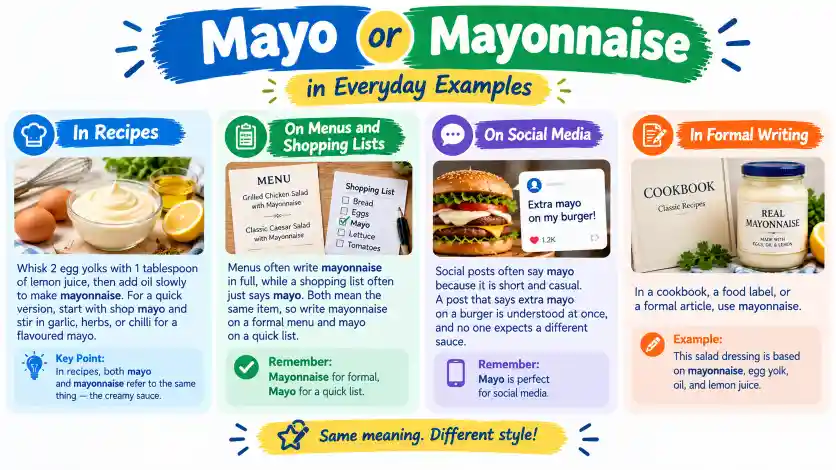
In Recipes
Whisk 2 egg yolks with 1 tablespoon of lemon juice, then add oil slowly to make mayonnaise. For a quick version, start with shop mayo and stir in garlic, herbs, or chilli for a flavoured mayo.
On Menus and Shopping Lists
Menus often write mayonnaise in full, while a shopping list often just says mayo. Both mean the same item, so write mayonnaise on a formal menu and mayo on a quick list.
On Social Media
Social posts often say mayo because it is short and casual. A post that says extra mayo on a burger is understood at once, and no one expects a different sauce.
In Formal Writing
In a cookbook, a food label, or a formal article, use mayonnaise. Example: This salad dressing is based on mayonnaise, egg yolk, oil, and lemon juice.
Mayo or Mayonnaise : Google Trends and Usage Data
What People Search For
People search for both words when they cook, shop, or check a recipe. Common searches include homemade mayonnaise, mayo vs Miracle Whip, vegan mayo, and if mayo is bad for health. The short word mayo is very common in casual searches, while mayonnaise is common in recipe and label searches.
Search Patterns by Context
Mayo searches often rise with sandwiches, burgers, salads, and summer picnic recipes. Mayonnaise searches often rise with homemade recipes, sauces such as tartar sauce and remoulade, and food safety questions. Both terms are searched widely in the United States, the United Kingdom, Canada, Australia, India, and Pakistan, among other countries.
How to Read Trends Without Wrong Claims
Search interest changes over time and by place. Without a current Google Trends check for your country and date, it is not right to claim one exact country is always on top. To check, open Google Trends, type mayo and mayonnaise, and pick your country and time range. The broad pattern stays the same: mayo is the casual short form, and mayonnaise is the full, standard name.
Mayo vs Mayonnaise: Comparison Table
At a Glance
| Feature | Mayo | Mayonnaise |
| Meaning | Short form of mayonnaise | Full name of the sauce |
| Base ingredients | Oil, egg yolk, acid | Oil, egg yolk, acid |
| Texture | Thick and creamy | Thick and creamy |
| Style | Informal, casual | Formal, standard |
| Best for | Talk, texts, casual recipes | Menus, labels, formal recipes |
| Flavoured versions | Garlic mayo, chipotle mayo | Garlic mayonnaise, chipotle mayonnaise |
| Not the same as | Dressing or spread that fails the mayonnaise standard | Dressing or spread that fails the mayonnaise standard |
Frequently Asked Questions
1. Is mayo the same as mayonnaise?
Yes. Mayo is simply short for mayonnaise. Both mean the same creamy sauce, unless the product label shows a different recipe such as light, vegan, or flavoured.
2. Is mayo a real word?
Yes. Mayo is an informal word in dictionaries, recorded as a clipping of mayonnaise. It is fine in casual writing, but mayonnaise is better in formal writing.
3. What is mayonnaise made of?
Traditional mayonnaise is made of oil, egg yolk, and vinegar or lemon juice, with salt and often mustard. The egg yolk holds the oil and acid together as a stable emulsion.
4. Is Miracle Whip mayonnaise?
No. Miracle Whip is a dressing, not mayonnaise. It is sweeter, tangier, and made to a different recipe, so it should not be labelled as mayonnaise.
5. Is vegan mayo real mayonnaise?
No, not in the traditional sense. Vegan mayo has no egg yolk, so it is an eggless imitation. It can taste similar and works in many dishes, but its recipe is different.
6. How long does mayonnaise last?
Shop mayonnaise, once opened, should be kept in the fridge and used by the date on the jar. Homemade mayonnaise, made with raw egg, should be kept cold and used within a few days, and it should not be left out for hours.
7. What sauces are based on mayonnaise?
Tartar sauce, remoulade, fry sauce, ranch dressing, and many flavoured mayos are based on mayonnaise. They start with mayonnaise and add herbs, pickles, garlic, chilli, or other flavours.
Conclusion
Mayo and mayonnaise are not two different sauces fighting for a place in your kitchen. Mayonnaise is the full, formal name for a thick, creamy emulsion of oil, egg yolk, and acid, and mayo is simply its short, casual form, in use since about 1930.
The confusion comes not from the words, but from the many products sold under them: light mayo, flavoured mayo, vegan mayo, and dressings that are not real mayonnaise at all. Once you know that, the choice becomes easy. Use mayonnaise in formal writing, menus, labels, and recipe titles, and use mayo in daily talk, texts, and casual recipes, and use the full word first for a global audience, then the short word after that.
Check the label if you need real mayonnaise, because a dressing or spread may look the same but follow a different recipe. Store shop mayonnaise in the fridge, use homemade mayonnaise quickly and keep it cold, and enjoy flavoured version such as garlic or chipotle mayo as variations, not as different base sauces. With that simple rule, you will never wonder again which jar to buy, which word to write, or mayo and mayonnaise are really the same thing.
Read More:
- Forward or Foward? Don’t Let This Spelling Mistake Fool You
- Simular or Similar? Discover the Correct Word and Its Meaning
- Tie or Tye? The One Spelling You Should Never Get Wrong Again






2 thoughts on “Mayo or Mayonnaise? The Simple Truth About That Creamy Jar”