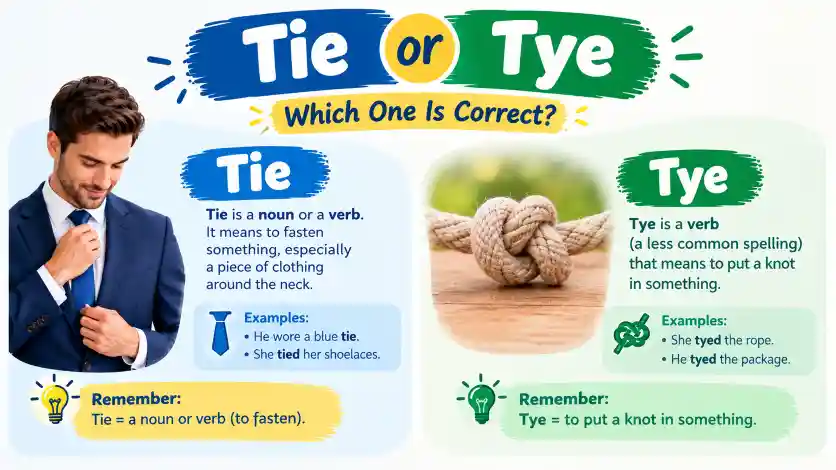
Tie is the correct spelling for everyday use. Tye is only a rare, old, or special word, not for daily writing.
Many people search for tie or tye because the two words sound exactly the same and are very hard to tell apart. They also look almost the same on the page, so just one small letter change can make a correct sentence look wrong.
This mix-up happens again and again in school work, office emails, and social media posts written in a hurry every day. It also happens a lot with tie-dye shirts, when people are not sure and write tye dye by mistake.
In this simple guide, you will learn the one clear rule, the easy meanings of both words, and the rare cases where tye is used. You will also see easy examples for daily life, school, work, and formal writing, so you will never need to guess again.
Tie or Tye : Quick Answer
Tie is correct for almost all modern writing. Use tie when you mean to fasten, to wear a necktie, or to end a game with an equal score.
Tye is not a modern replacement for tie. It is an old form of tie, and it also has a few rare, special meanings. Do not use it in daily writing.
Correct Examples
- Correct: Please tie your shoes before you run.
- Correct: He wore a blue tie to the office.
- Correct: The match ended in a tie.
Incorrect Examples
- Incorrect: Please tye your shoes before you run.
- Incorrect: He wore a blue tye to the office.
- Incorrect: The match ended in a tye.
Simple rule: If you mean the everyday word, write tie.
Definition and Meaning of Tie or Tye
What Does Tie Mean?
Tie is a common English word. As a verb, it means to fasten with a knot, cord, string, or ribbon. As a noun, it can mean a necktie, a cord, or an equal score.
What Does Tye Mean?
Tye is a rare and old word. Old English, it was a form of tie. In sailing, a tye can mean a rope or chain used to lift a yard on a ship. In mining, it can mean a trough used to wash ore. Some parts of the UK, it can also mean a patch of common land, often a village green.
Simple Meaning in One Line
- Tie: to fasten, to wear around the neck, or to draw in a game.
- Tye: an old or special word, not used in normal daily English.
Context and Usage
Use tie when you talk about shoes, clothes, gifts, sports, work, and daily life. Use tye only when you talk about old texts, sailing history, mining history, or a place name. In most cases, context tells you the answer: if it is a normal sentence, it is tie.
Different Meanings of Tie
Tie as a Verb
Its means to fasten or join with a knot.
- Example: She will tie the ribbon on the gift.
- Example: Please tie the dog to the post for a short time.
Tie as a Noun for Clothing
A tie is a long piece of cloth worn around the neck, often with a shirt and suit.
- Example: He bought a red tie for the wedding.
- Example: A clip-on tie is easy to wear.
Tie as a Noun for an Equal Score
In sports, a tie means both teams or players have the same score.
- Example: The game ended in a tie.
- Example: Both teams shared first place after a tie.
Tie as a Noun for a Cord
A tie can also mean a cord, string, or band used to hold things together.
- Example: Use a tie to close the bag.
- Example: The plant needs a soft tie to stay upright.
The Origin of Tie or Tye
Where Did Tie Come From?
Tie comes from an old English word for a cord, band, or bond. Over time, the spelling became fixed as tie. It kept the idea of joining, holding, or fastening things together.
Why Does Tye Exist?
In old English, spelling was not fixed. The same word could be written in more than one way. Tye was one old spelling of tie. Later, modern English chose tie as the standard form.
Tye also has other roots. One old sense comes from a word for a chest or box, which later gave the mining sense of a trough. That is why tye can look like a different word in old or special texts, even though it shares sounds with tie.
Why People Mix Them Up
People mix them up for three clear reasons:
- They sound the same. Tie and tye are homophones.
- They look almost the same. Only the last letters change.
- Tye is also a name. As a name, Tye looks normal, so people think it must be a normal word too.
The sound is the same, but the use is not the same.
British English vs American English Spelling
Is Tye the British Spelling?
No, tye is not the modern British spelling. In both British and American English, the correct everyday spelling is tie. Some low-quality guides claim tye is British, but that is not true for modern writing.
Same Spelling in the US and UK
British and American English both use tie for a knot, a necktie, and an equal score. They both use tied as the past tense. They both use tie-dye for the shirt method.
Comparison Table: British vs American English
| Feature | British English | American English |
|---|---|---|
| Correct everyday spelling | Tie | Tie |
| Old or special spelling | Tye | Tye |
| Past tense | Tied | Tied |
| Shirt method | Tie-dye | Tie-dye |
| Equal score | Tie | Tie |
Key point: There is no US vs UK split here. Tie wins in both.
Which Spelling Should You Use?
For US Readers
Use tie in all cases. Write tied, not tyed. Write tie-dye, not tye dye. US readers will see tye as a spelling error in normal text.
For UK and Commonwealth Readers
Use tie as well. British, Australian, Canadian, and other Commonwealth readers also use tie in school, work, and daily life. Tye may appear in old place names or history, but it is not the right choice for a normal sentence.
For Global Readers
Use tie for a global audience. Readers in Pakistan, India, the US, the UK, Canada, and Australia will all know tie. Tie is clear, safe, and standard everywhere.
For Professional Writing
In emails, reports, CVs, and formal letters, always use tie. A small error like tye can make good work look careless. If you are not sure, read the sentence aloud and check the meaning.
For Names
Tye can be a personal name. As a name, it starts with a capital letter, as in Tye. That is a different case. Do not use the name spelling for the common word.
Common Mistakes with Tie or Tye
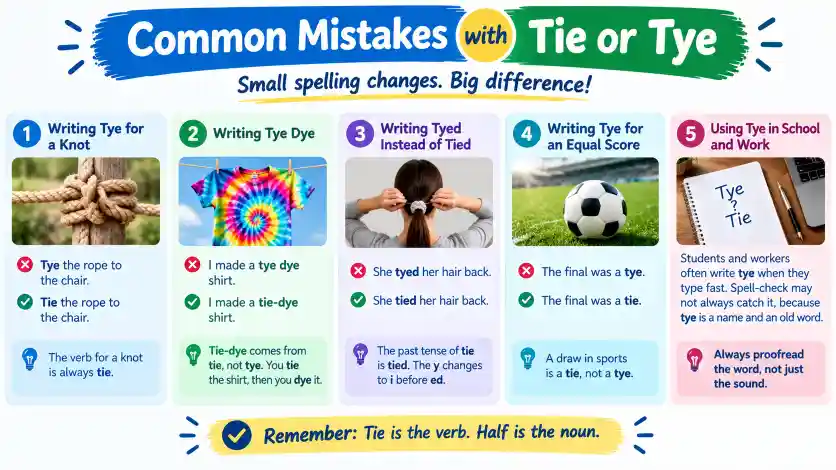
1. Writing Tye for a Knot
- Incorrect: Tye the rope to the chair.
- Correct: Tie the rope to the chair.
The verb for a knot is always tie.
2. Writing Tye Dye
- Incorrect: I made a tye dye shirt.
- Correct: I made a tie-dye shirt.
Tie-dye comes from tie, not tye. You tie the shirt, then you dye it.
3. Writing Tyed Instead of Tied
- Incorrect: She tyed her hair back.
- Correct: She tied her hair back.
The past tense of tie is tied. The y changes to i before ed.
4. Writing Tye for an Equal Score
- Incorrect: The final was a tye.
- Correct: The final was a tie.
A draw in sports is a tie, not a tye.
5. Using Tye in School and Work
Students and workers often write tye when they type fast. Spell-check may not always catch it, because tye is a name and an old word. Always proofread the word, not just the sound.
Tie or Tye in Everyday Examples
In Emails
- Example: Please tie up the loose ends before Friday.
- Example: I will send the tie-in offer with the report.
- Incorrect in an email: Please tye up the loose ends.
In News Writing
- Example: The two teams played to a tie in the final match.
- Example: The minister wore a dark tie at the press meeting.
- Example: The new rail line will use steel ties to hold the track.
On Social Media
- Example: Just learned how to tie a bow tie in 30 seconds.
- Example: Our team fought hard for a tie, not a loss.
- Example: My new tie-dye shirt is ready for summer.
In Formal Writing
- Example: The contract will tie both sides to the same terms.
- Example: The chair wore a formal suit and tie to the event.
- Example: The vote ended in a tie, so the chair cast the final vote.
In each case, the everyday word is tie.
Tie or Tye : Google Trends & Usage Data
Why Tie Is Searched Far More
Tie is searched far more than tye. Tie is a daily word for clothes, sports, school, and work. Tye is searched far less, and often for a name, an old word, or a spelling check.
Popularity by Country and Context
People in the United States, the United Kingdom, Canada, Australia, India, and Pakistan may search for spelling help with tie or tye. Tie-dye searches also rise in summer and fashion seasons. Tye searches are more likely to link to a name or to a rare, special use.
How to Read Trends Without Wrong Claims
Search interest changes over time. Without a current Google Trends check for your country and date, it is not right to claim one exact country is always on top. To check, open Google Trends, type tie and tye, and pick your country and time range. The broad pattern stays the same: tie is the main word, tye is the rare word.
Tie vs Tye: Comparison Table
Tie vs Tye at a Glance
| Spelling | Meaning and Use | Correct in Modern Writing? | Example |
|---|---|---|---|
| Tie | Fasten, necktie, equal score | Yes | Please tie your shoes. |
| Tye | Old form of tie, sailing rope, mining trough, village green | Only in old or special use | The sailor checked the tye on the ship. |
| Tied | Past tense of tie | Yes | She tied the knot. |
| Tyed | Old past form of tye | No, in modern writing | Do not use tyed for tied. |
| Tie-dye | Tie and dye method for shirts | Yes | She made a tie-dye shirt. |
| Tye dye | Misspelling of tie-dye | No | Do not write tye dye. |
| Tye | Personal name | Yes, as a name only | Tye is his first name. |
Frequently Asked Questions
1. Is tie or tye correct?
Tie is correct for everyday use. Tye is only correct in old, special, or name uses.
2. Is tye a real word?
Yes, but it is rare. Tye is an old form of tie, and it also has special meanings in sailing, mining, and old UK place names. It is not a normal modern word.
3. Is tye the British spelling of tie?
No. British English also uses tie. Tye is not the modern British form for a knot, a necktie, or a draw.
4. Is it tie dye or tye dye?
It is tie-dye. You tie the cloth first, then you dye it. Tye dye is a common misspelling.
5. What is the past tense: tied or tyed?
The past tense is tied. For example, she tied her shoes. Tyed is not used in modern writing.
6. Can Tye be a name?
Yes. Tye can be a first name, often a short form of names like Tyler. As a name, it starts with a capital T. That does not make tye correct for the common word.
7. How can I remember the spelling?
Think of the action: tie it. If you mean fasten, wear, or draw, write tie. If you are writing a name or an old text, check the context first.
Conclusion
The main rule is simple. Use tie for everyday writing. Use it for a knot, a necktie, a cord, and an equal score in a game. Do not use tye in school, work, or daily messages. Tye is not the modern British spelling. It is an old form of tie, and it also has a few rare, special meanings in sailing, mining, and old place names.
Those cases do not change the rule for most people. If you are writing about a shirt, write tie-dye, not tye dye. If you are writing about a name, Tye can be a name, but that is a different case. Check your work before you send it. Read the sentence and ask what you mean.
If you mean fasten, wear, or draw, the word is tie. This one check can save you from a small but clear spelling error. Keep this rule in mind, use the examples in this guide, and you will write tie with ease and confidence in every kind of English writing.
Read More:
- Forward or Foward? Don’t Let This Spelling Mistake Fool You
- Simular or Similar? Discover the Correct Word and Its Meaning
- Caput or Kaput? The Right Answer Will Surprise You



2 thoughts on “Tie or Tye? The One Spelling You Should Never Get Wrong Again”