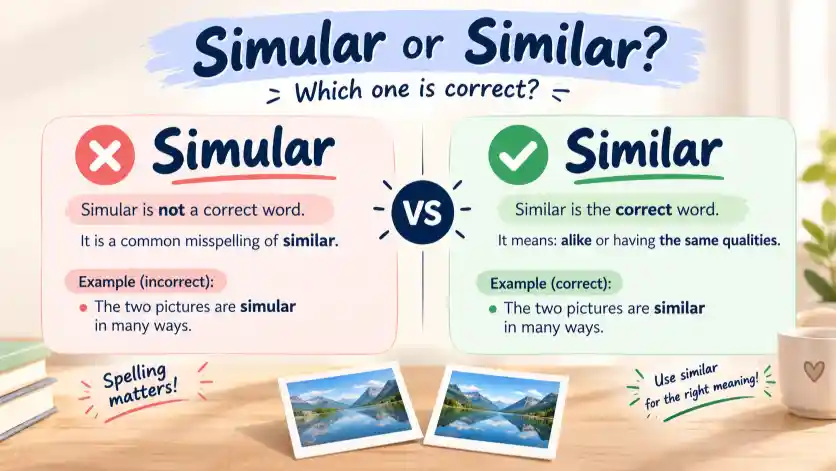
People often search for simular or similar because the two words look and sound alike. The correct spelling in standard English is similar. The word simular is a common spelling mistake, not the standard form used to describe things that share the same features, qualities, or appearance.
For example, you should write, “These two books have similar stories,” rather than “These two books have simular stories.” The correct spelling is important in school assignments, emails, business documents, and everyday writing.
This confusion is easy to understand. English has many words with similar sounds, and the letter patterns in some words can make spelling harder to remember. Words such as familiar, popular, and regular may also lead some writers to form the incorrect spelling simular.
In this guide, you will learn the meaning of similar, its origin, the difference between British and American usage, and how to use it in real sentences. You will also find common mistakes, helpful memory tips, examples, and answers to frequently asked questions. By the end, you will know which spelling to use and how to avoid this mistake in your writing.
Simular or Similar: What Is the Correct Spelling?
Similar is the correct spelling in standard English. It describes two or more people, things, ideas, or situations that share features or qualities. Simular is a misspelling and should not be used in ordinary English writing.
For example:
- Correct: The two houses look similar.
- Incorrect: The two houses look simular.
- Correct: We have similar opinions about the project.
Remember to write similar, with an i after the first letter s.
Simular or Similar: Quick Answer
The correct choice between simular or similar is similar. It means alike or nearly the same in some way, but it does not always mean exactly identical. Use it when comparing people, objects, ideas, or situations that share important features.
Examples:
- My shoes are similar to yours.
- The students have similar interests.
- Both plans offer similar benefits.
The spelling simular is incorrect in standard English. Use similar in academic, professional, and everyday writing.
What Does Similar Mean?
The word similar is an adjective. It describes things that share some features but may still have differences.
Definition of Similar
Similar: Alike in appearance, character, nature, quality, or other important features.
Two things can be similar without being exactly the same. For instance, two phones may have similar cameras but different prices, sizes, or battery lives.
Simple Meaning of Similar
In simple words, similar means almost the same in some way.
Consider these examples:
- Two friends have similar tastes in music.
- The shops sell similar products.
- My answer is similar to yours.
In each sentence, the people or things share something in common.
How to Use Similar in a Sentence
The word similar often appears with the preposition to.
Examples:
- This dress is similar to the one I bought yesterday.
- Her writing style is similar to her teacher’s.
- The new design is similar to the original version.
You can also use similar before a noun.
Examples:
- Similar problems can occur during installation.
- We have similar goals.
- The two teams followed similar strategies.
A useful pattern to remember is similar to, not usually similar with, when making a direct comparison.
The Origin of Similar
The word similar has a long history in English. It entered English through French and Latin word forms associated with likeness and resemblance.
It is linked to the Latin word similis, which means “like” or “similar.” The related Latin word similitudō refers to likeness or resemblance.
Over time, similar became a common English adjective used to describe things that share qualities or characteristics.
Why Do People Spell It as Simular?
The incorrect spelling simular may develop because writers confuse the ending with other familiar English words. People may also spell a word according to how they think it sounds.
However, the accepted spelling is similar. The word’s history does not support replacing the second i with a u.
Here is an easy way to remember its spelling:
S + I + M + I + L + A + R = SIMILAR
Break the word into smaller parts when learning it:
- SIM
- I
- LAR
Practicing the correct spelling in short sentences can help you remember it.
British English vs American English
There is no spelling difference between British and American English for this word. Both use similar.
Some English words change spelling across regions, such as colour and color. However, similar keeps the same spelling in both varieties.
| British English | American English | Example |
| Similar | Similar | The two designs are similar. |
| Similar to | Similar to | This result is similar to mine. |
| Similarly | Similarly | Both teams performed similarly. |
| Similarity | Similarity | There is a clear similarity between them. |
Does Similar Change in Other English-Speaking Countries?
No. The standard spelling is also similar in Canada, Australia, and other English-speaking regions.
Writers do not need to change this word to match a regional spelling guide. The same rule applies in formal writing, education, publishing, and business communication.
Which Version Should You Use?
Always choose similar in standard English writing. The correct spelling does not depend on your country or audience.
United States
American English uses similar in schoolwork, emails, reports, and everyday communication.
Example: “The two companies provide similar services.”
United Kingdom
British English also uses similar. There is no alternative British spelling.
Example: “The two buildings have similar designs.”
Canada
Canadian English uses similar in both formal and informal writing.
Example: “These products have similar features.”
Australia
Australian English follows the same spelling rule.
Example: “The students completed similar tasks.”
International Writing
If you write for an international audience, use similar. Readers across English-speaking regions will recognize it.
Academic Writing
Use similar when comparing studies, theories, results, or arguments.
Example: “The researchers found similar results in both experiments.”
Business Writing
Use similar to describe products, services, strategies, or outcomes.
Example: “Our company offers similar solutions at competitive prices.”
Best advice: Do not use simular as an alternative spelling. It is not the standard form in any of these varieties of English.
Common Mistakes With Simular and Similar
The most common mistake is replacing the second i in similar with a u. This creates simular, which is incorrect in standard English.
Mistake 1: Using Simular in a Sentence
Incorrect: The two bags have simular designs.
Correct: The two bags have similar designs.
Explanation: The adjective must use the standard spelling similar.
Mistake 2: Writing Simular in an Email
Incorrect: We offer simular services to our customers.
Correct: We offer similar services to our customers.
Explanation: Professional writing should use the accepted spelling so the message looks clear and polished.
Mistake 3: Using Similar When You Mean Identical
Incorrect: The two documents are similar, so every detail must be exactly the same.
Better: The two documents are identical in every detail.
Explanation: Similar means alike in certain ways. It does not guarantee that two things are exactly the same.
Mistake 4: Using the Wrong Preposition
Less natural: This design is similar with the original.
Correct: This design is similar to the original.
Explanation: The usual expression for a direct comparison is similar to.
Easy Memory Tip
Remember this simple rule:
Similar has two i’s before the ending “lar.”
Think of the spelling as sim-i-lar. When you need to compare two things, use similar, not simular.
Everyday Examples of Similar
The best way to learn a word is to see how people use it in different situations.
1. Emails
“The two proposals contain similar ideas, but the prices are different.”
This sentence compares the ideas while making it clear that another feature differs.
2. Business Writing
“Our latest product has similar features to the previous model.”
The word helps describe shared features without claiming that both products are identical.
3. News Headlines
“Two Cities Face Similar Challenges During the Summer”
Here, similar tells readers that both cities face challenges of the same general kind.
4. Blogs
“Many beginners make similar mistakes when learning English spelling.”
This sentence refers to mistakes that share common patterns.
5. Social Media
“These outfits have similar colors. Which one do you prefer?”
The word makes a comparison and invites readers to share their opinions.
6. Academic Writing
“The results of the second experiment were similar to those of the first experiment.”
This example compares research results using a clear, formal sentence.
7. Daily Conversation
“Your phone looks similar to mine.”
This is a natural way to say that two phones look alike.
8. School Assignments
“The two stories have similar themes, but their endings are different.”
The sentence shows that the stories share an important feature without being exactly the same.
9. Product Reviews
“This laptop offers similar performance at a lower price.”
The word helps compare products based on their performance.
10. Everyday Comparisons
“My brother and I have similar hobbies.”
This means both people enjoy some of the same activities.
Google Trends & Modern Usage
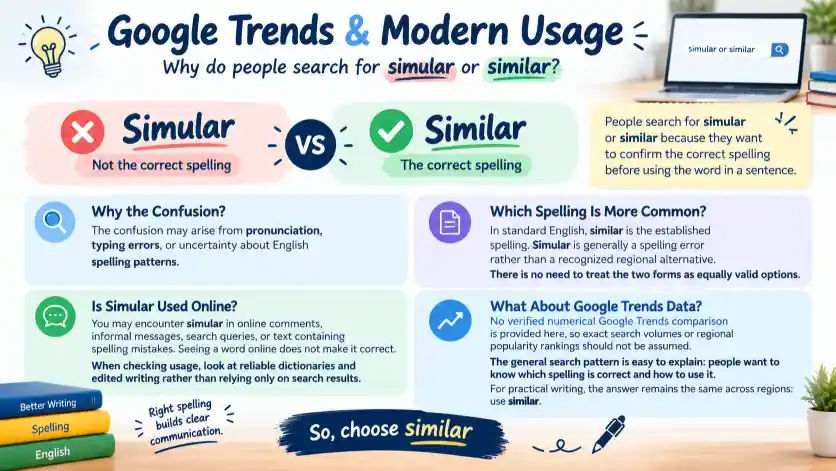
People search for simular or similar because they want to confirm the correct spelling before using the word in a sentence. These searches often come from students, English learners, writers, and people checking their work.
The confusion may arise from pronunciation, typing errors, or uncertainty about English spelling patterns.
Which Spelling Is More Common?
In standard English, similar is the established spelling. Simular is generally a spelling error rather than a recognized regional alternative.
There is no need to treat the two forms as equally valid options.
Is Simular Used Online?
You may encounter simular in online comments, informal messages, search queries, or text containing spelling mistakes. Seeing a word online does not make it correct.
When checking usage, look at reliable dictionaries and edited writing rather than relying only on search results.
What About Google Trends Data?
No verified numerical Google Trends comparison is provided here, so exact search volumes or regional popularity rankings should not be assumed.
The general search pattern is easy to explain: people want to know which spelling is correct and how to use it. For practical writing, the answer remains the same across regions: use similar.
Quick Comparison Table
| Version | Meaning | Correct? | Region | Example |
| Similar | Alike in some ways | Yes | Worldwide | The two rooms look similar. |
| Simular | Intended as a form of similar | No | Not a standard regional spelling | Incorrect: They have simular ideas. |
| Similarly | In a similar way | Yes | Worldwide | Both students responded similarly. |
| Similarity | The quality of being alike | Yes | Worldwide | We noticed a similarity between the pictures. |
This table also shows that similar, similarly, and similarity are related words, but they serve different grammatical roles.
- Similar is an adjective.
- Similarly is an adverb.
- Similarity is a noun.
Learning these forms can improve both spelling and sentence structure.
Key Takeaways
- Similar is the correct spelling in standard English.
- Simular is a common misspelling.
- Similar means alike in some features or qualities.
- The spelling is the same in British, American, Canadian, and Australian English.
- Use the expression similar to for most direct comparisons.
- Similar things do not have to be exactly identical.
- Similarly and similarity are correct related words with different grammatical uses.
- When in doubt, remember the spelling S-I-M-I-L-A-R.
FAQs About Simular or Similar
1. Is it simular or similar?
Similar is correct. It is the standard English adjective used to describe people or things that share certain features or qualities. Simular is a misspelling and should not be used in standard writing. For example, write “The two pictures look similar,” not “The two pictures look simular.”
2. Is simular a real English word?
Simular is not the standard spelling of the adjective meaning alike. You may see it in informal writing or as a typing error, but the correct word is similar. For schoolwork, professional communication, and published content, always choose the standard form.
3. What does similar mean in simple words?
Similar means almost the same in one or more ways. Two people might have similar interests, or two products might have similar features. They do not need to be exactly alike. The word simply shows that they share some qualities or characteristics.
4. How do you spell similar correctly?
Spell it S-I-M-I-L-A-R. The word contains two letter i’s, and the second one appears after the letter m. A helpful technique is to say the word slowly while writing each letter. Practicing sentences such as “These ideas are similar” can also help you remember it.
5. Is similar spelled the same in British and American English?
Yes. Both British and American English use similar. Unlike words such as colour and color, this word does not have different standard regional spellings. The same spelling is used in Canada, Australia, and other English-speaking countries.
6. What is the difference between similar and identical?
Similar means that two things share some features, while identical means they are exactly the same in the relevant respects. For example, two shirts may have similar colors but different patterns. If two copies match in every detail, you can describe them as identical.
7. Should I write similar to or similar with?
Use similar to for a direct comparison in standard English. For example, write “This painting is similar to the original.” The phrase similar with is generally not the natural choice in this construction. Remember the common pattern: something is similar to something else.
8. What are synonyms for similar?
Common synonyms include alike, comparable, related, resembling, and analogous. The best choice depends on the sentence. For example, alike works well in everyday speech, while comparable is useful when discussing products, performance, or results. These words are related in meaning but are not interchangeable in every context.
9. What is the noun form of similar?
The noun form is similarity. It refers to a quality or feature that two or more things share. For example, “There is a strong similarity between the two designs.” The adverb form is similarly, as in “Both teams performed similarly.”
10. How can I avoid confusing simular and similar?
Remember that the correct word is similar, with an i after the m. Use a spelling checker when needed, and read your sentence before submitting it. You can also practice writing the word in short comparisons, such as “My answer is similar to yours.” Repeated use will help make the correct spelling familiar.
Conclusion: Simular or Similar?
When choosing between simular or similar, always use similar. It is the correct spelling in standard English, and it describes people, objects, ideas, or situations that share some features or qualities.
The spelling does not change between British and American English. It remains similar in Canada, Australia, academic writing, business documents, and everyday conversation.
Remember that similar things are not always identical. Two products can have similar features but different prices, and two people can have similar interests but different personalities. When making a direct comparison, the phrase similar to is usually the right choice.
If you see simular in a message or online post, treat it as a spelling mistake rather than an alternative form. A simple spelling check can help you avoid the error and make your writing clearer.
The easiest rule to remember is this: write similar, never simular, when you mean alike. If this guide helped you, use the examples to practice the correct spelling in your own sentences.
Read More:
- Temporarily or Temporary? Learn the Difference in Seconds
- Cummerbund or Cumberbund: Which Spelling Is Correct in 2026?
- Forward or Foward? Don’t Let This Spelling Mistake Fool You


2 thoughts on “Simular or Similar? Discover the Correct Word and Its Meaning”